487th Bomb Squadron
B-25 Pilot Charles M. Cook
BIOGRAPHY

Edited by his son Doug Cook. Comments and corrections welcome.
ALL RIGHTS RESERVED
Last update June 18 2010
If you knew Charles Cook in the Army Air Corps, please email me with
any stories you may have to share.
340th
Bomb Group 487th Squadron INDEX
|
CHARLES COOK Military Career Chronology
|
|
|
|
|
DATE
|
ACTION
|
|
|
|
|
April 28, 1941
|
Drafted to Ft. Sheridan, IL
|
|
December 7, 1941
|
Pearl Harbor attacked; US enters
WWII
|
|
May 26, 1942
|
Transferred from
Pvt. 627th Tank Destroyer Bn.
|
|
|
to Aviation Cadet Ft. Ord. CA
|
|
July 28, 1943
|
Graduated 2nd Lt. Pilot Yuma, AZ
|
|
July 29, 1943
|
Transferred
Columbia Army Air Base, SC
|
|
|
309th BG 378th BS B-25 G strafing training
|
|
February 21, 1944
|
Unlimited Pilot rating
|
|
February 21, 1944
|
Transferred to 340th BG 487th Squadron
|
|
February 28, 1944
|
Orders received to ship overseas
|
|
|
through N. Africa to base at Guado (Paestum), Italy
|
|
March 22, 1944
|
Vesuvius erupts destroying base and
planes
|
|
March 31, 1944
|
First training sortie in theater
|
|
April 3, 1944
|
First combat mission
|
|
April 13, 1944
|
Moved from Guado
Base to Alesan, Corsica
|
|
May 13, 1944
|
Germans attack Alesan
Air Base
|
|
June 12, 1944
|
Promoted to 1st
Lt.
|
|
December 1, 1944
|
Promoted to
Captain, US Army Air Corps
|
|
January 29, 1945
|
Completed 72 combat missions
|
|
February 12, 1945
|
Transferred back to US by Air
Transport Command
|
|
|
via Casablanca
to Dakar, Senegal
to Natal, Brazil
to Miami
|
|
April 17, 1945
|
Assigned Minter Field, CA
|
|
May 31, 1945
|
Yuma, AZ as C.O. Training squadron 80 pilots
with 80 students
|
|
September 10, 1945
|
to Ft. Sheridan, IL released from service but joined reserves
|
|
|
into 1948
|
Anecdotes from
Dad
This
autobiographical accounting of his WWII service was written around 1988.
I started my
military career on April 28, 1941 after I was selected to represent my community in the Armed Service (DRAFTED!) for one year.
I was sent
to Fort Sheridan, Illinois for indoctrination and clothing. I was at Fort Sheridan
only a few days and was assigned to an infantry company in the Illinois
National Guard 33rd Division at Camp Forest, Tennessee. I spent only a few weeks in this infantry company when I
was assigned to the military police company because of my experience riding a
motorcycle. Life was not too bad in this unit except we
very seldom got a weekend leave due to doing
police duty in Nashville.
On December
7, 1941, war was declared. My year of active duty was down the
drain. I was in for the duration.
I was not
very satisfied to be in a military police unit during the war, so I, along with
several other men, volunteered to go to a tank destroyer unit at Fort
McClellan, Alabama.
Life was
miserable in this unit. Everyone was discontented, including the
officers. The food was terrible; in fact we pulled a strike and would not
fall out for reveille. The Captain was really flabbergasted. He
finally got us in formation about the middle of the
afternoon and asked us what was wrong. Everyone
complained about the food. He asked if any cooks had come with us. Two
volunteered to cook, of which one was a mechanic. The next morning the
mess hall was spic and span and we had a nice meal of bacon and eggs.
That night we had pie for dessert which I never expected in the Army. This took care of the food problem,
but the personnel discontent was still there. Everyone was trying to get out. The
Colonel was not cooperative because he wanted to keep his unit at full strength to go overseas.

Left to Right
brothers and sister;
Orrin, Edith, and
Charles ca 1943 2nd Lt B-25 Graduates
before shipping out
to different theaters of WWII
Since my
brother Orrin had been accepted for pilot training I decided to try. [ Orrin V. Cook became a B-25 pilot assigned to the Pacific
Theater with the 345th BG 500th Squadron at Port Moresby,
New Guinea. He met with tragedy on his third mission when he was hit by
anti-aircraft fire over the Japanese held base at Wewak, New
Guinea. A 75mm AA round took off two
of his fingers and ripped through his cheek and nose. Thankfully he survived
and was out of action.] I started to get my credentials
together. We moved to San Louis Obispo in California in preparation to go overseas, but I still kept
trying. After I got all my papers together I was held up by the Colonel
who did not want to loose any of his unit. I
knew that the air force had priority and had a confrontation with the
Colonel. The Adjutant agreed with me and convinced the Colonel he had no
right to hold up my application. In a fit of anger he approved my application. I
spread the news to the other men and there was a flood of applications for Air Force and Officer Training.
Before I had
all my tests completed we moved to Fort Ord, California to prepare for shipping out
for overseas duty. As it turned out I passed the physical exam one morning, wrecked my motorcycle that
afternoon and ended up in the hospital. The next morning the unit got
orders to go overseas. I stayed in the hospital until my wrist was healed and
was then assigned to a replacement unit where I pulled guard
duty until I was called to the Air Corps. I left Fort Ord, went to Santa Ana Camp Air Base at Santa Ana, California. Here we had more
physicals, mental test and many other tests to see if we were pilot material. Those of us
that were left-after this spent two months of studies and close order drills.
|
Charles Cook Transferred from Pvt.
627th Tank Destroyer Bn.
|
|
to Aviation Cadet Ft. Ord. CA
|

My next
move was to Primary Cal-Aero Academy at the Ontario, California. This had been a school
for civilian pilots before the war. There was not much military at this
base, just the business of learning to fly plus meteorology,

Charles Cook
learning to fly a Stearman .
|
|
mechanics, etc. We flew the Stearman which was an open cockpit, bi-wing plane.


Charles Cook learning
to fly a Stearman .
After two
months here we moved on to basic training at Merced Army Air Base at Ontario, California. Here we flew a BT-13A which was a low wing closed
cockpit plane. We learned to fly cross country, formation, and night
flying.
Our next
move was to Yuma Army Air Base, Yuma, Arizona. Here we flew the AT-17
and AT-9 which were low wing twin engine planes.
We continued
to fly cross country, formation and more night
flying but now we are flying with a co-pilot.
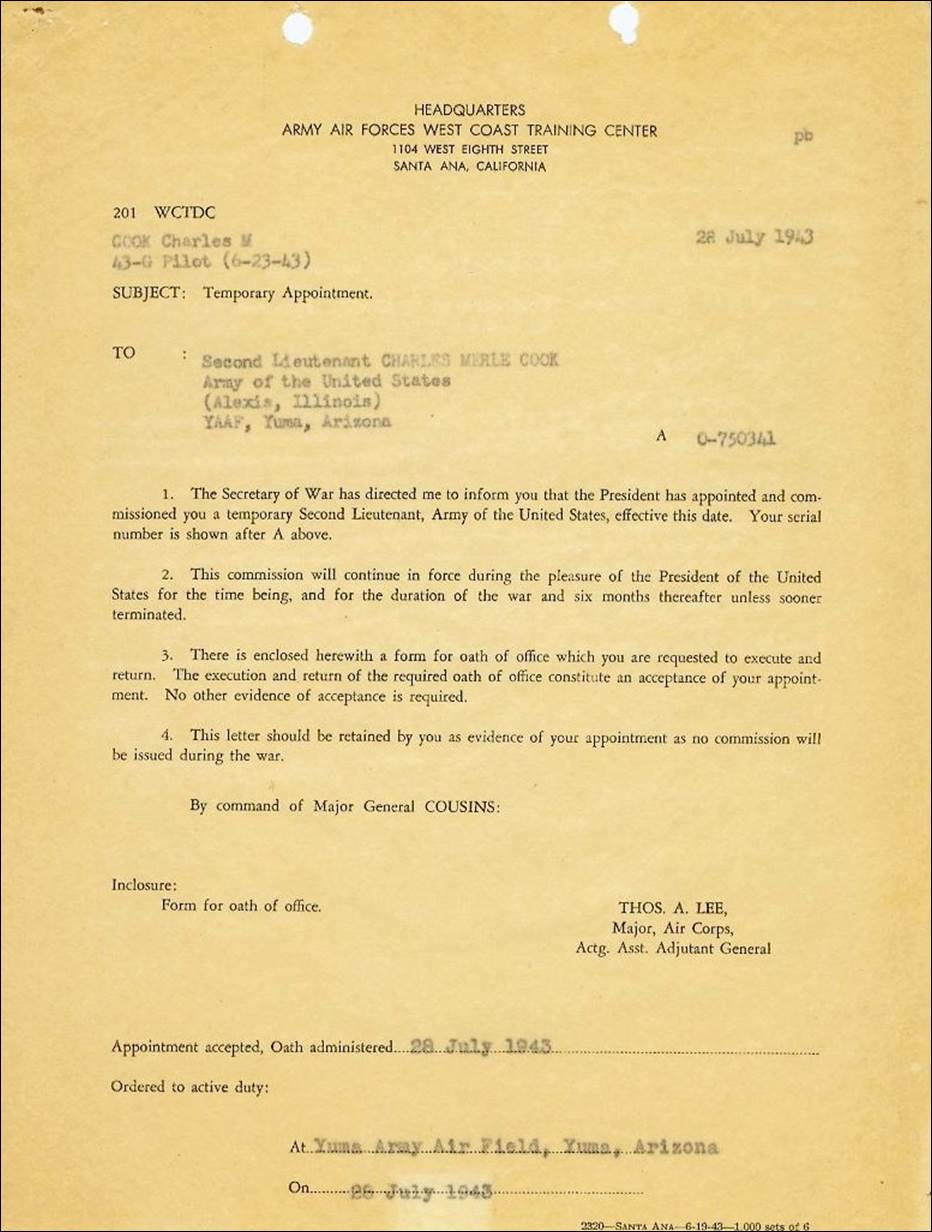
I graduated
as a Second Lieutenant on July 28, 1943. 1 had asked to fly B-25s and I
was lucky enough to get my choice. From Yuma I was
assigned to the Sacramento Army Air Base at Sacramento, California, which was a transition school to learn to fly the
B-25. The training was the same as in advance except
it was in a combat plane. From Sacramento I was sent to the Columbia Army Air Base at Columbia, South Carolina, where I was assigned a crew. My training was to be in
a B-25G. This plane carried a 75 mm cannon in its
nose, therefore, I did not have a bombardier
or co-pilot. The plane had only one set of controls and the navigator sat in the co-pilots seat. His duties included
loading the cannon. We trained together
for several months.
|
Charles Cook Graduated
2nd Lt. Pilot Yuma, AZ
|
|
Transferred Columbia Army Air Base,
SC
|
|
309th BG 378th BS B-25 G strafing training
|
|
|


Crew training 309th BG 378th Sq
Thompson, Cook, Yuskutat, Worsham,
Zlacket, Thompson


B-25 G rigged with a
75 mm cannon in Corsica.
From Columbia we
were sent to Savannah, Georgia, to prepare for overseas
and to get our assignment for theatre of war. I was assigned to Southern Europe.
From Savannah we
went to Newport News and boarded a ship on which we spent nine days and landed at Casablanca in Africa.
After a few days at Casablanca we were flown to a replacement depot somewhere in Northern Africa.
I have forgotten where this was.
From here I
was assigned to the [57th Bomb Wing- 340th Bomb Group]
487th Bombardment Squadron at Guado (Paestem) Italy. It had been at Pompeii but Mount Vesuvius
erupted ruining the field and all the
planes. They received new planes from the replacement depot in Africa and
moved in with another group at Paestem.

Ancient Greek Temple
at Paestum
[The eruption of
Vesuvius of 1944 occurs shortly after the arrival in Naples
of the allied forces in World War II. The eruption caught by surprise the
military and destroyed the air force planes stationed in the airport
of Terzigno
east of the mountain. An entire wing of 88 B-25’s was damaged by the
eruption.]
The only thing the men already over there could talk
about was how rough it was flying over the Anzio
beachhead. [Attacks on Monte Cassino on 17th January,
1944 resulted in the Germans reserves moving to the Gustav Line and on 22nd
January the 6th Corps landed at Anzio. Lucas decided not
to push straight away to the Alban Hills. This enabled General Heinrich Vietinghoff to order the 14th Army to return to the area
and contain the 6th Corps on the Anzio bridgehead. General Mackensen counterattacked on 15th February 1944 but this
was halted by the American troops. Winston Churchill was furious with Lucas and
commented "I had hoped that we were hurling a wildcat onto the shore, but
all we got was a stranded whale." General George Marshall accepted the
criticism and Lucas was replaced by General Lucian Truscott. On 18th May, 1944,
Allied troops led by General Wladyslaw Anders (Polish
Corps) and General Alphonse Juin (French Corps)
captured Monte Cassino. This opened a
corridor for Allied troops and they reached Anzio on 24th May. The
German defense now disintegrated and General Mark Clark was able to take his
forces direct to Rome which he liberated
on 4th June, 1944.
Excerpted ]


B-25 in formation
flying into very heavy “hot” flak.
All planes
in the area were called in to help the allies break out and move on
into Italy. The area was covered with a low overcast, requiring the flights to fly under
them to hit their targets. This made them sitting ducks for enemy
anti-aircraft fire. The losses were very heavy. Even the group
commander was shot down. Axis Sally of the
German propaganda station report that he was taken prisoner uninjured. On my third mission we were shot up pretty badly,
having 107 holes in the plane. Our radio man was the only one
injured. He got a small piece of flak in his
thigh, but it was only minor. He was flying again three days later.


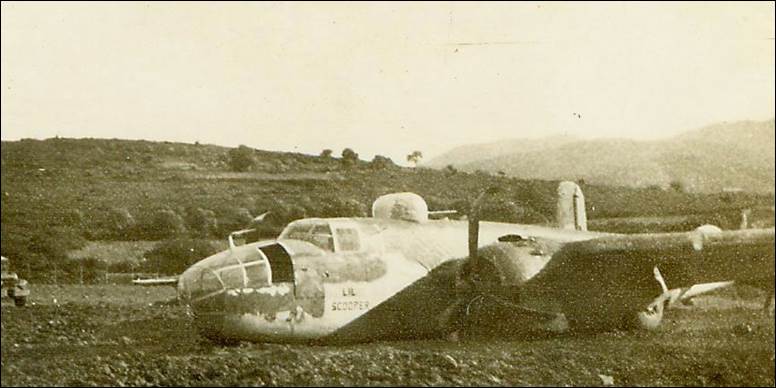
B-25 “LIL SCOOPER”
after a belly landing
We were only
on Italian soil about six weeks when we moved to Corsica. [The
340th Bomb Group moved to Alesan, Corsica
from Guado (Paestum) on April 14, 1945. The base of the 340th Bomb Group at Alesan
Airfield was attacked in the early morning hours of May 13, 1944 by the German
Air Force.

Alesan Air Base in the aftermath of
the German Raid May, 13, 1944
Note: 487th Planes
7N and 7P survived
Photo courtesy of Herman Voss- custodian of John Sterrett-Tail
Gunner 486th BS
[This
according to “Axis Sally” was in retaliation for US bomber dropping phosphorous
bombs on anti-aircraft gun positions. The US began this practice where anti-aircraft flak became
extremely heavy and dangerous to tactical bombing missions. The attacking German
force was estimated at 20-30 planes which bombed and strafed the airbase. The
attack lasted about an hour and fifteen minutes. Casualties were exceedingly
high from the strafing, bombing, and B-25’s blowing up with full bomb loads.
(Excerpted from 489th Squadron Book from Q. Kaiser) Noteworthy is that my father never mentioned this
horrific incident in any of his recounts of his duty on Corsica.
ANECDOTES
FROM DAD:
1)
While on a training
mission off Corsica, Dad was returning to base along the coast a low altitude
and noticed some local women sunbathing on the beach. He banked the B-25 around for another “close”
pass and got so close to the beach that his copilot remarked, “Damn! Charlie
you flew the plane right underneath those girls!”
2)
On a bombing mission,
the plane took flak damage and the bomb racks jammed so the bombs wouldn’t
drop. He did not want to land back at
base with a full bomb bay, so when over open water, he crawled back into the open
bomb bay and kicked on the stuck bombs until they let loose! That one reminds
me of Slim Pickens in ‘Dr. Strangelove’.
Thankfully, Dad held on tight, got the bomb bay closed, and landed
safely.
Also
noteworthy is the way he painted a rather mundane picture of the very real
danger the crews faced on each and every mission. The only crew photo he had in his collection
is posted here with him in front of the B-25 “McKinley Jr. High.”
Soon after this photo, that plane was shot down by German flak over Griciliana, Italy killing the pilot and top turret and waist gunners. (The
tale is well written by the surviving co-pilot Harry D. George in his book “Georgio
Italiano
” ISBN 1-55212-538-6 ]
CREW PHOTO of McKINLEY JR. HIGH after her MAIDEN MISSION MAY 19, 1944
PLANE was SHOT DOWN JUNE 22, 1944

“Left to right) Pilot 1st
Lt. William A. McLaughlin ; Pilot 2nd Lt. Charles M. Cook (photo credit);
Radio
Operator/Gunner T/Sgt. Harvey Hyland;Turret Gunner/Engineer Sgt. Eugene Simonson;
Tail Gunner
Sgt. Robert Bishop; Copilot 2nd Lt. George Simpson
(shot down April 6 and made it back!)
(kneeling)
Crew Chief S/Sgt. Howard Pinneo; Asst. Crew Chief/ Gunner S/Sgt
Charles Floyd


Charles
Cook at the controls of B-25 “Rum Dum”

Charles
Cook at the controls- Ready for action?


From Corsica we could hit Southern France as well as Italy. We even
flew across Italy to bomb a bridge in Yugoslavia. Bombing bridges was about the only targets
we hit. We even got a citation for 63 hits in a row. The purpose of
bombing bridges was to keep the German
troops from getting supplies. [First Lt. Charles Cook was awarded the
Distinguished Flying Cross while based in Corsica for his participation in the
Allied “D” Day invasion of southern France. While bombing bridges in Avignon, his plane was hit by flak from German
anti-aircraft guns. He managed to keep his plane on course and successfully
dropped his bomb payload on target.]

Lt.
Charles Cook
Awarded Distinguished Flying Cross
We stayed on Corsica for the duration of my
stay overseas. I had flown 70 missions and according to the group
commander I automatically had combat fatigue.
When I first arrived overseas the crews were sent home after 50
missions, before I had flown that many it
was raised to 60. Before reaching 60 it was changed requiring us to fly
until we had combat fatigue, whatever that is. [Note this is the
“Catch-22” theme: Author Joseph Heller
was in the 489th Squadron at Alesan,
Corsica]
I saw enemy fighters only
once. I was leading a box of six planes on the right side of a flight consisting of three boxes. Three
ME-109s attacked the box on the left. One was shot down and the
only damage we received was one wounded tail
gunner.


487th SQUADRON MISSION SHEET JAN. 20, 1945:
Charles Cook now promoted to Captain is assigned as squadron lead plane 7H on a mission to hit German RR
lines in Trento, Italy in the Brenner Pass. Note that
plane and crew 7L did not return from the mission. Credit: Dominic Taddei

[BRENNER PASS: Operation Bingo
On 6, November 1944 the Germans were
holding the high ridges in the Northern Apennine mountains they called THE GOTHIC LINE. This defense line ran
through the mountain ranges that reached, almost unbroken, from La Spezia on the north west coast of Italy to the City of Rimini on the Adriactic. Near
the center and behind the German lines was the important transportation center
of Bologna. Rail lines bringing war supplies from Germany, were for the most part routed through the Brenner Pass. Other rail lines from Austria were further east and led south into Venice and then into Bologna. These were the two main transportation lines that
fueled the German machines in Italy. It was estimated that 24,000 tons of supplies was
flowing to the German troops each day. That was five times the minimum daily
requirements needed to support the German troops that were locked in a winter
stalemate with our Allied forces. On the 6th. of November 1944, Operation BINGO was put into
effect. It's objective was to stop the flow of German goods coming to the
fighting front by closing off the Brenner Pass.
The four B-25 bomb groups belonging to the 57th Bomb Wing were to carry the bulk of the load.
The German's main defensive

weapon was the 8.8cm. Fliegerabwehrkanone,
shortened to Flak. The 88 fired a 9.24KG (20.34 pound) shell to over
49,000 feet. It was coupled with the KG 40 gun director and the 41D gun laying
radar. The primary defense fell to the German 5th. and 127th. Flak Regiments
that manned the 366 heavy, anti-aircraft guns that were stationed from Verona,
in the south, to Innsbruk, in the north with more
heavy guns moved in around Ala and Rovereto.
In January, 1945, flak batteries continued to increase. More guns moved into Bressanone and Verona. There were now 475 heavy guns
guarding the Brenner. Some were stationed in the mountains as high as 3000 feet
above sea level. One battery, west of Ala, was
reported at the 4100 foot level. Anti-flak operations continued with a new
twist, with a formation of three B-25 anti-flak planes leading the bombing
formation, dropping chaff and white phosphorous bombs to burn the gunners and
hide the formation with the smoke. Despite these efforts, of the 48 missions
flown over the Brenner, 1250 sorties, that month, 39 drew flak, Two hundred and
twenty four aircraft were holed and 5 lost. Excerpted from an article By Frank B. Dean,
380th., 310th.]
[Losses during the battles over the Po River Valley and
Brenner Pass were high during the interdiction campaign these units conducted.
The 489th BS lost 75 aircraft (three times its assigned strength) while was
flying out of Alasan, Corsica, either because they
didn’t return from missions or couldn’t be repaired after limping back. ]
I flew home by Air Transport
Command, starting from Naples, Italy. We had three day layovers at Casablanca, Dakar, Africa, Natal Brazil
and up to Miami. [Arrival in Miami February
12, 1945]
I went home for two weeks and
then back to Santa Ana for redistribution in
the training command. From here I was sent to Minter Field, at
Bakersfield, California. My stay at Minter was short. They turned
the field over to the Chinese and we
were sent to Yuma of all places. At Yuma we were training
bombardiers and navigators in radar bombing and navigation. We would fly
the planes to 10,000 feet and set them on automatic pilot and let them fly to the training target and back. When back
over the field we would let down and land again.
Charles Cook Biography
|
|

Bonnie (Rahn) Cook (age 20)
|
|

Edward and Fanny (McCaw) Cook

Left to Right brothers and
sister;
Orrin, Edith, and Charles ca 1943 2nd Lt B-25 Graduates
before shipping out to
different theaters of WWII

Bonnie Rahn 1945 Age 20

Charles and Bonnie Cook
post-war newlyweds
Charles Merle Cook was born
on March 17, 1918 in a farmhouse in Alexis, Illinois to Edward (born circa 1865
died circa 1955) and Fanny (McCaw) Cook. He was number 14 of 15 children.
Charles Cook and Bonnie Rahn met in June, 1945 and
were married November 11, 1945. Then Dad went to college on the G.I. bill
at Augustana College and graduated from University of
Illinois (Champagne) with a BS in
Ceramic Engineering (circa
1950). Charles was the first in his family to graduate from college. He first
worked for Frigidaire in Clyde, Ohio, then Whirlpool in Clyde, Ohio.
While he and Mom lived in a 28 foot trailer, he built a house in Miamisburg,
Ohio with Al Siska’s help. All three children were
born in Ohio (Karen Sue- July 6, 1951; Gregory Charles- July 13, 1953; Douglas
John- March 25, 1955). In 1957, we moved to Benton Harbor, Michigan where
Dad worked for Whirlpool for 18 years. In 1975, Dad and Mom moved to Rock
Spring, GA where Dad worked for Roper until retirement in 1983. He was
fond of fishing, gardening, and engineering projects to enhance their home. Charles Merle Cook died on March 25, 1994 in
Ft. Oglethorpe, GA. He is buried in the Chattanooga, TN National Cemetery with
a headstone citation of his war service record.

INDEX